A landmark is only the beginning
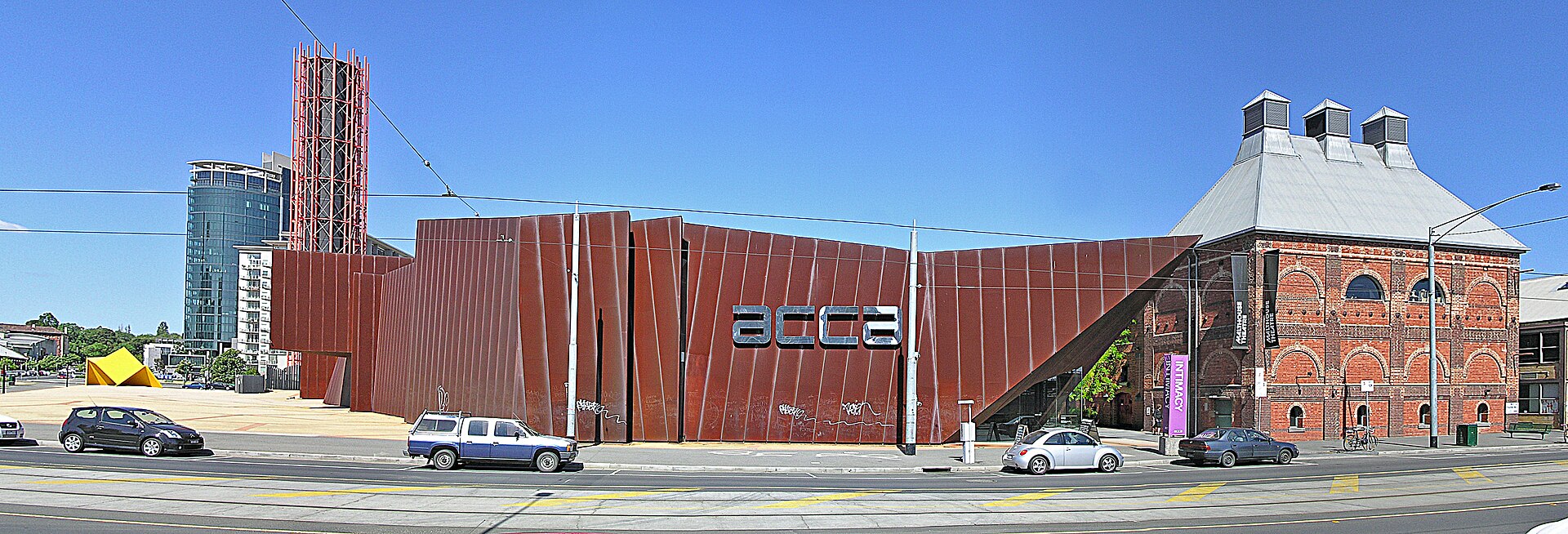
The Australian Centre for Contemporary Art is easy to recognise in photographs: its rust-coloured exterior has a strong presence on Sturt Street. Yet the building is a starting point rather than a summary of what happens inside.
ACCA’s institutional history records its establishment in 1983 and its move to the Wood Marsh-designed Southbank building in 2002. Its work includes commissioning new art, exhibitions, education and public programs. That emphasis makes the current exhibition, not a permanent list of familiar objects, the useful basis for planning a visit.
Read the outside at different distances
From across the street, the building can be read as a broad shape and a continuous surface. Closer views reveal joints, changes in plane and the relationship between the contemporary building and its neighbours. The accompanying photograph makes those contrasts visible without pretending to describe an interior exhibition.
For anyone interested in architectural photography, this suggests a simple exercise: make one wide contextual image and one closer study. Ask what each explains that the other cannot. A tightly framed surface may be striking while saying little about where the building sits.
Give unfamiliar work a fair amount of time
Contemporary exhibitions may ask for different kinds of attention. A moving-image work has a duration; an installation may depend on the relationship between several elements. Check the exhibition information before deciding how quickly to move through it.
When a work is difficult to understand, begin with what is physically present. What material, sound, scale or movement are you encountering? Then use the artist and curator texts to connect those observations to the work’s context. This is a more productive start than trying to guess a hidden correct answer.
Plan around the actual program
Check ACCA’s current exhibition dates, opening information and access guidance directly. A recognisable exterior does not mean the galleries are available between installations, and an older review does not describe the current program.
Pair the visit with another nearby cultural stop only if the timing leaves room to look. The value of a changing exhibition space is the chance to encounter something you did not already know. Give that encounter enough space in the day to be more than a stop beside a famous façade.