Translation is a creative act
A painting or photograph can supply a tapestry design, but thread cannot simply behave like paint or a digital pixel. A woven work requires decisions about colour, edge, texture and scale. Those decisions are part of the artwork’s making.
The Australian Tapestry Workshop, established in Melbourne in 1976, describes its practice as collaboration with artists working across media. Its weavers use an adaptation of the Gobelin technique, forming the image by packing horizontal weft threads over vertical warp threads. The workshop also maintains a dye lab and exhibition spaces.
Source: Australian Tapestry Workshop: history and weaving practice.
Look from two distances
From a distance, a tapestry may read as a continuous image. Closer inspection can reveal the small material decisions that sustain it: neighbouring colours, changes in direction and the construction of an edge. Move between those distances where gallery conditions allow.
Ask which details become stronger through weaving and which have to change. A soft transition in a source image might require a different solution from a hard outline. This is a way to appreciate interpretation without assuming that a successful tapestry must reproduce every mark literally.
Read the full making credit
The designer, weavers and dyer may have distinct roles. Look for those names in the work’s documentation and learn how the collaboration was organised. A concise label cannot always convey the length or complexity of that exchange.
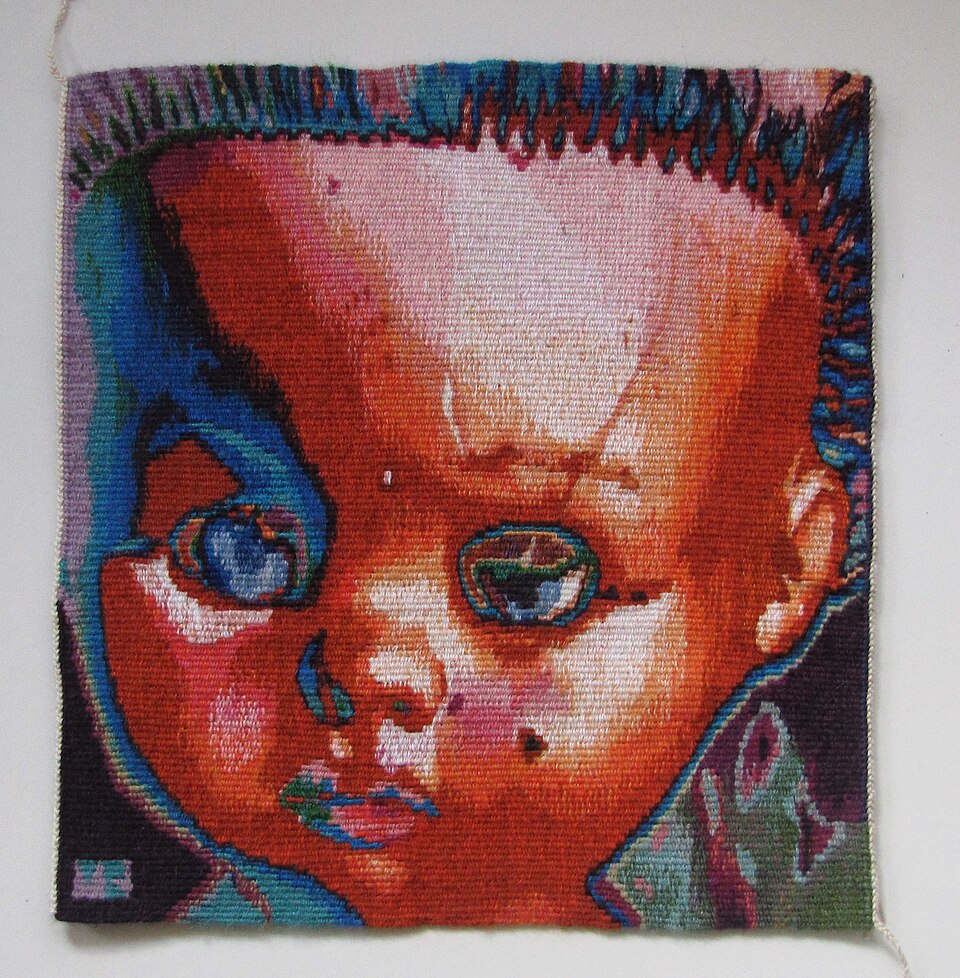
The photograph accompanying this article shows Marilyn Rea-Menzies’s tapestry Doll as an example of a woven image. It is not presented as an ATW commission. Its visible threads offer a useful starting point for considering how an image is constructed through material rather than applied to a surface.
Visit with a process question
Consult the workshop’s current exhibition and tour information before travelling. A working studio has different access arrangements from an unrestricted gallery, and the opportunity to watch a particular work develop will depend on the program.
A good question might be how a colour is chosen, how a design is enlarged or how several makers keep an image coherent. Those questions connect the finished surface to the people and decisions behind it. They also make clear why a tapestry is worth considering as a work in its own medium, rather than as a large textile copy of something else.