Start with the ground, not the skyline
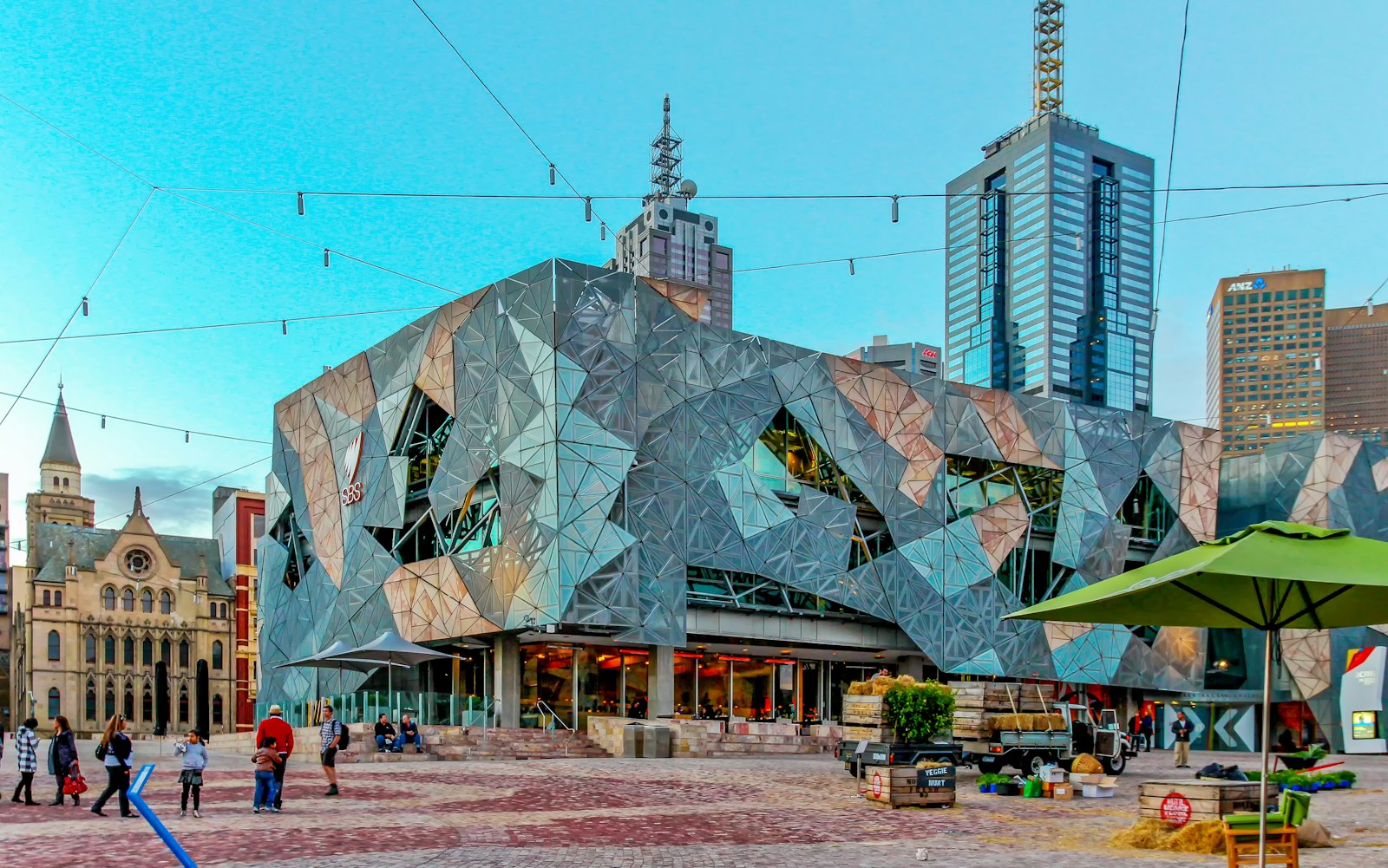
Federation Square is often photographed as a collection of angular façades. For a more useful reading, begin with how people cross it. Notice where a route continues, where a level changes and where a sheltered edge invites someone to pause.
The precinct’s own design history describes a sequence of interlocking spaces rather than one enclosed plaza. Designed by LAB Architecture Studio with Bates Smart, Federation Square opened in 2002. Its public spaces sit above railway infrastructure, so the apparent ground is itself a major constructed element.
Follow the façade’s repeating logic
Sandstone, zinc and glass form the building skins. Fed Square explains that the triangular pattern is assembled at several scales, with small units combining into larger panels. That gives a close detail a relationship to the wider elevation.
Try looking at a single panel, then stepping back until the pattern becomes part of the building’s mass. The material changes matter as much as the geometry: a glazed section admits views and reflections while a solid surface behaves differently in the same light. A photograph can isolate that contrast without needing an entire building in frame.
Notice the less visible engineering
The deck beneath the precinct separates sensitive cultural uses from an active railway. Fed Square’s account describes steel support, concrete elements and vibration isolation as part of that structure. Those systems are not as immediately visible as the cladding, but they explain how the place can function.
This is a useful reminder when reading architecture: the memorable surface and the supporting work answer different questions. One shapes recognition; the other enables galleries, cinemas and gathering spaces to occupy a difficult urban site.
Make a short architectural walk
Choose a route from the city edge towards the river, allowing for current access and events. Record three observations: a connection to the surrounding city, a change in enclosure and a material junction. Keep clear of circulation routes when stopping for photographs.
Then compare those notes with a single postcard-style view. The wider image may identify the landmark, while the small observations explain how it is used. Federation Square becomes more legible when considered as a set of relationships between buildings, infrastructure and everyday movement.