A city institution built around making
Craft Victoria began in 1970 as an organisation representing Victorian craftspeople. Its history includes premises at the Meat Market, Gertrude Street and Flinders Lane before its current home in Watson Place, off Flinders Lane.
Today its work spans exhibitions, professional development, commissions and the presentation of functional and sculptural objects. That breadth makes it a useful place to expand an idea of craft beyond a single material or a familiar shopping category.
Check the current programme before visiting and allow time for a small number of objects. A close look at three works can be more revealing than a quick survey of everything on display.
First, ask what the material is doing
Begin with what you can see. Is the surface absorbing light or reflecting it? Does the work appear heavy, delicate, rigid or flexible? Read the label to distinguish an observation from an assumption: an unfamiliar treatment can make a familiar material difficult to recognise.
Then ask how the material contributes to the object’s idea. A polished surface might emphasise an exact contour; a visible join might make assembly part of the work. Neither is automatically a sign of greater quality. The interesting question is why that choice belongs to this particular object.
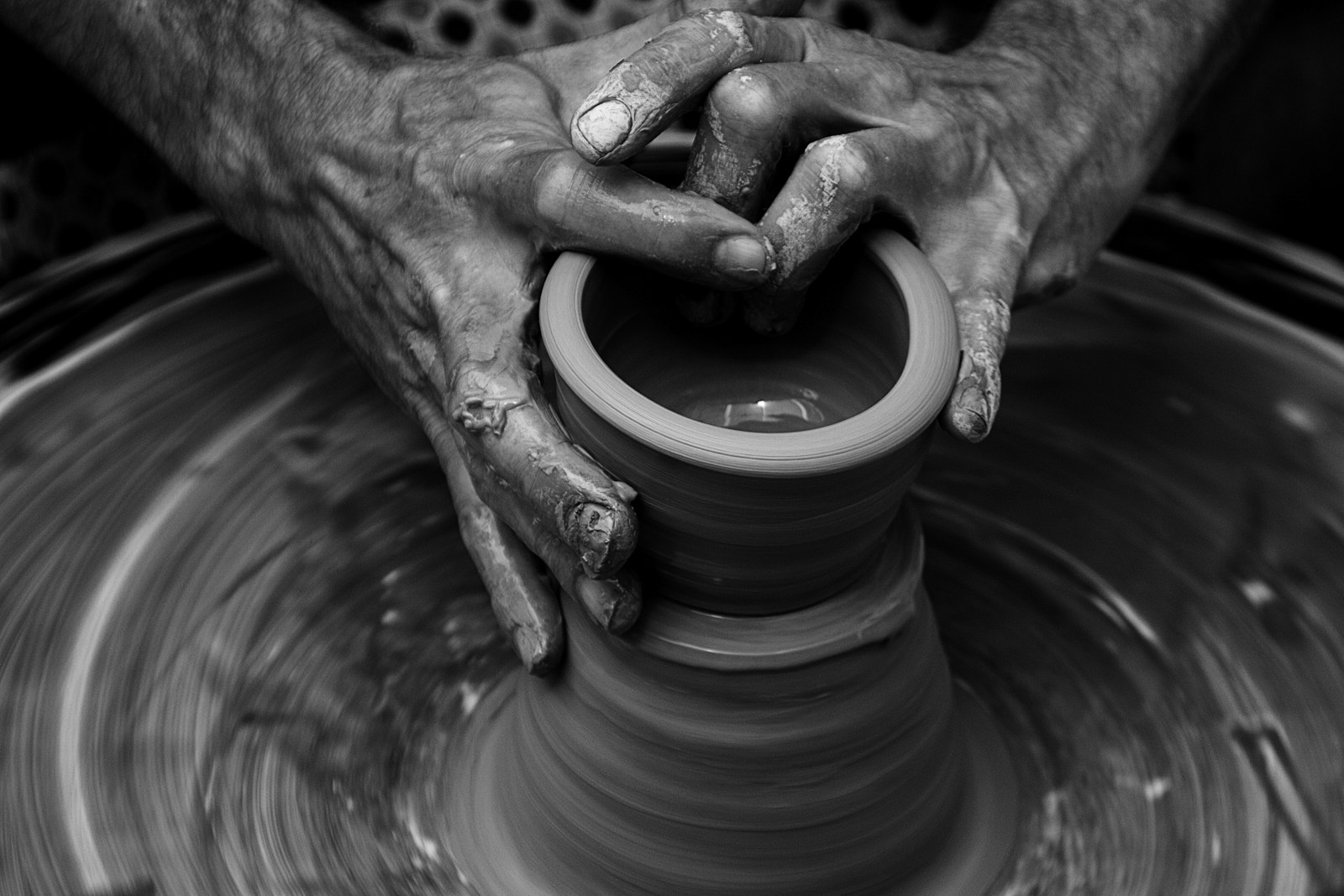
The pottery photograph accompanying this article is an illustration of making. It does not identify a Craft Victoria exhibitor or represent the current installation.
Next, look for a decision in the construction
Find a place where something changes: an edge, seam, attachment, bend or transition between surfaces. Notice whether the maker draws attention to it or tries to make it disappear. If the work is presented behind glass, use the available views and ask staff rather than handling it.
For example, with a vessel you could compare the opening and the base. With a textile, you might look at how a repeated element changes near an edge. These are suggested looking exercises, not descriptions of works guaranteed to be on display.
Our stories on Australian Print Workshop and Australian Tapestry Workshop offer further ways to think about decisions made during production, including the role of collaboration.
Finally, consider how you would live with it
For a functional object, ask about use and care alongside appearance. What is it made to hold, support or accompany? Which parts are intended to be touched? If purchasing, ask for the maker’s instructions rather than inferring durability from weight or finish.
A sculptural work can invite a different relationship: where you would encounter it, how its silhouette changes as you move and what kind of space lets it be seen. Avoid forcing every object into a household purpose it was not designed to serve.
Record the maker’s name and the title or series that interests you. Craft’s online maker directory provides another route for exploring practices after the visit. Following one maker over time can reveal a development that a single object cannot: recurring questions, changes in technique and the confidence to leave an earlier solution behind.